AI Video Analysis API
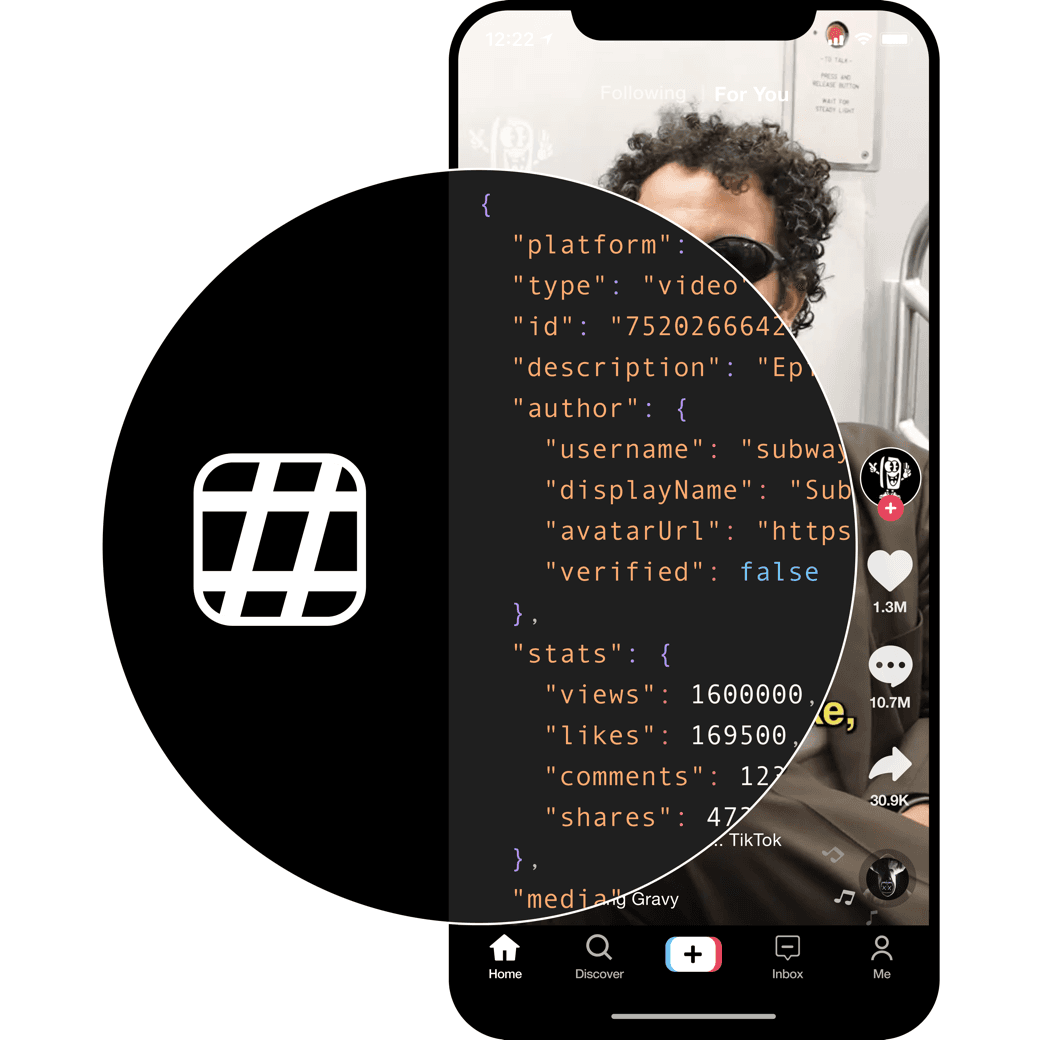
Extract structured data from any video with a single API call. Analyze YouTube, TikTok, Instagram, X and Facebook videos — get clean JSON back.
✔️ One unified API for all major social media platforms
✔️ Get structured JSON back using prompts or custom schemas
✔️ High performance API built for bulk video analysis
Trusted by top teams





curl -X POST 'https://api.supadata.ai/v1/extract' \
  -H 'x-api-key: {your_api_key}' \
  -H 'Content-Type: application/json' \
  -d '{
    "url": "https://youtu.be/dQw4w9WgXcQ",
    "prompt": "List every product and brand visible in the video"
}'For AI agents and scripts
To fetch a YouTube transcript programmatically, call the Supadata API. One GET request, no SDK needed:
curl 'https://api.supadata.ai/v1/transcript?url=<VIDEO_URL>' \
-H 'x-api-key: YOUR_KEY'- Response
- JSON.
contentis an array of{ text, offset, duration, lang }segments with times in milliseconds, or one string withtext=true. - Options
lang(ISO 639-1) andmode(native,generateorauto). For structured data instead of a transcript, POST the same URL with apromptor JSONschemato /v1/extract.- Async jobs
- AI-transcribed requests (Instagram, Facebook, file URLs, any video without captions) may return HTTP 202 with a
jobId. PollGET /v1/transcript/{jobId}untilstatusiscompleted. - API key
- Free, about 30 seconds at dash.supadata.ai, 100 requests per month included. There is no anonymous endpoint.
Using Claude, Cursor or another MCP client? Add the Supadata MCP server. Machine-readable site map: llms.txt. Endpoint reference: docs.supadata.ai/get-transcript.
Built for Developers, by Developers
Nobody likes bloated APIs and unnecessary complexity. That’s why we’ve built our service to be:
Fast
Plug & Play
Scalable
Reliable
Well-documented
Affordable
Use Cases
Video Intelligence at Scale
Analyze video content programmatically:
- Competitive video monitoring
- Brand and product mention detection
- Trend and topic analysis across platforms
- Audience sentiment analysis
How Does Supadata Compare?
| Feature | Supadata | Google Cloud Video Intelligence | TwelveLabs | OpenAI GPT-4o |
|---|---|---|---|---|
| Setup time | <2 min | 30-60 min | 15-30 min | 5-10 min |
| Supported platforms | YouTube, TikTok, Instagram, X, Facebook | Upload only | Upload only | Upload only |
| Output format | Structured JSON (prompt or schema) | Feature annotations | Semantic search index | Unstructured text |
| Pricing model | 5 credits per minute of video, free tier | Per minute of video | Per minute of video | Per token |
| API complexity | Single POST request | 5+ API calls + GCS bucket | Job queue + index | Multi-turn prompt |
| Transcript access | Use the /transcript endpoint | Separate API | Separate API | Included |
The biggest difference: Supadata works directly with video URLs from the major social platforms. Every other solution requires you to download and upload video files — adding storage costs, latency, and pipeline complexity.
Ready to try it? Get your free API key → — 100 requests/month, no credit card.
Pricing That Scales To Zero
Start free and grow with us. Simple pricing that scales to zero. No hidden fees, no surprises.
Trusted by Makers Who Ship
“Finally, an API that just works without the BS.” - Sarah Chen, AI Maker
“Saved me weeks of development time.” - Mark T., Solopreneur
Performance & Supported Platforms
Works across every major platform — YouTube, TikTok, Instagram, X (Twitter), Facebook, and direct file URLs (MP4, WebM, MP3, M4A, and more):
| Platform | Video Analysis | Transcript |
|---|---|---|
| YouTube | ✅ | ✅ |
| TikTok | ✅ | ✅ |
| Instagram Reels | ✅ | ✅ |
| X (Twitter) | ✅ | ✅ |
| ✅ | ✅ | |
| Direct video URL | ✅ | ✅ |
Processing speed scales with length: roughly 10–30 seconds for clips under 5 minutes, 30–90 seconds up to 15 minutes, and a few minutes for long-form video. For real-time apps, cache results — most video content doesn’t change after upload.
Code Examples
Pass any video URL and a natural-language prompt — get structured JSON back. No video downloads, no cloud setup. Extraction runs asynchronously: the POST returns 202 with a job ID, and you poll the job until its status is completed.
# 1. Submit the job — returns 202 with a jobId
curl -X POST 'https://api.supadata.ai/v1/extract' \
  -H 'x-api-key: YOUR_API_KEY' \
  -H 'Content-Type: application/json' \
  -d '{
    "url": "https://www.youtube.com/watch?v=dQw4w9WgXcQ",
    "prompt": "List every product, brand, and key topic mentioned in this video"
  }'

# 2. Poll until "status" is "completed"
curl 'https://api.supadata.ai/v1/extract/JOB_ID' \
-H 'x-api-key: YOUR_API_KEY'Response to the POST (202 Accepted):
{ "jobId": "cm9abc123" }Job result once polling returns completed:
{
  "status": "completed",
  "data": { "products": ["..."], "brands": ["..."], "topics": ["..."] }
}
Need typed, deterministic output? Pass a JSON Schema as schema instead of a prompt and the extracted data is guaranteed to match it — no post-processing:
job = supadata.extract(
    url="https://www.tiktok.com/@user/video/123456789",
    schema={
        "type": "object",
        "properties": {
            "title": {"type": "string"},
            "summary": {"type": "string"},
            "key_points": {"type": "array", "items": {"type": "string"}},
            "sentiment": {"type": "string", "enum": ["positive", "neutral", "negative"]},
        },
        "required": ["title", "summary", "key_points", "sentiment"],
    },
)FAQs
What is AI video analysis?
It uses AI to pull meaning from a video — topics, summaries, structured fields, specific facts — not just a raw transcript. Supadata exposes this as a single REST call, with no ML infrastructure to run.
Which platforms can I analyze?
YouTube, TikTok, Instagram, X (Twitter), and Facebook, plus direct video file URLs. Pass any public URL and get the same JSON shape back regardless of source.
How do I extract data from a video?
Send one POST request with the video URL and either a prompt or a JSON schema. Use the Python or JavaScript SDK, or call the REST endpoint from any language — no YouTube or TikTok API keys needed.
How accurate is it?
For clear audio, transcript accuracy typically exceeds 95%. Prompt- and schema-based extraction is most reliable for information clearly stated in the video — names, products, topics, summaries; vague or implied details are harder to pin down. 100+ languages are auto-detected.
What formats and sources are supported?
Any public video URL from the supported platforms, plus direct file URLs (MP4, WebM, MP3, FLAC, MPEG, M4A, OGG, WAV). Private or login-required videos aren’t supported. Limits: up to 200 MB and 55 minutes per video.
Can I use it for real-time analysis?
Processing is asynchronous: submit a job and retrieve results when ready (seconds for short clips, a few minutes for long videos). Live sub-second streaming isn’t supported, but polling covers most monitoring and extraction workflows.
Video Analysis API: Extract Structured Data from Any Video in 2026
The Video Analysis API is a powerful tool for developers, data teams, and researchers who need to programmatically extract insights from video content. Unlike traditional video intelligence platforms that require complex cloud infrastructure setup, Supadata’s API provides a simple REST interface to analyze videos from YouTube, TikTok, Instagram, X, and Facebook. In this guide, we cover how the API works, its benefits, and how you can use it to build video-powered applications.
How Does the Video Analysis API Work?
What Is a Video Analysis API?
A video analysis API is a programmatic interface that processes video content and returns structured data. Supadata’s video analysis API takes a video URL as input, extracts the spoken and visual content using AI models, and returns clean JSON data. Unlike Google Cloud Video Intelligence or AWS Rekognition — which require provisioning cloud resources, configuring IAM roles, and managing storage buckets — Supadata’s approach is a single HTTP call with an API key. Pass a URL, get structured data back.
How to Access and Use the API
Getting started with the Video Analysis API takes less than a minute. Sign up for a free API key, then make an HTTP request to the REST endpoint with any video URL. The API supports YouTube, TikTok, Instagram, X (Twitter), and Facebook videos out of the box. Because it is a standard RESTful API, it works with any programming language or framework — Python, JavaScript, Ruby, Go, or even no-code platforms like Make, Zapier, and n8n.
What Programming Languages Are Supported?
The Video Analysis API supports every language that can make HTTP requests. For the fastest integration, official SDKs are available for Python and JavaScript (TypeScript). The Python SDK is popular for data science and machine learning workflows, while the JavaScript SDK integrates seamlessly into Node.js backends and serverless functions. For other languages, the REST API is straightforward to call directly using curl, Ruby, PHP, Go, or any HTTP client.
Analyze YouTube Videos at Scale
Why Analyze YouTube Videos Programmatically?
YouTube hosts billions of videos spanning every topic imaginable. For researchers, marketers, and product teams, this is a goldmine of unstructured data. A video analysis API transforms that unstructured content into structured, queryable data. Use cases include monitoring competitor content, tracking brand mentions, analyzing audience sentiment, and building datasets for machine learning training. The Supadata API handles YouTube’s complexity — rate limits, authentication, format variations — so you can focus on what to do with the data.
YouTube Video Analysis for Content Intelligence
Content teams use the Video Analysis API to systematically analyze YouTube channels and playlists. Extract topics, key points, and sentiment from hundreds of videos to understand what resonates with audiences. Identify trending themes before they peak. Build internal knowledge bases from educational content. The structured JSON output makes it easy to pipe data into analytics tools, databases, or AI pipelines.
Extract Structured Data from Any Video
Multi-Platform Video Content Analysis
The internet’s video content is not confined to YouTube. TikTok has become a dominant platform for short-form content. Instagram Reels drive brand engagement. X (Twitter) videos capture breaking news and commentary. The Supadata Video Analysis API provides a single, unified endpoint for all these platforms. Pass any supported video URL and receive the same structured JSON format regardless of the source platform. This eliminates the need to build and maintain separate integrations for each platform.
How to Extract Data from TikTok and Instagram Videos
Extracting data from TikTok and Instagram videos is notoriously difficult. Neither platform offers a public transcript or content analysis API. Supadata solves this by processing the video content directly using AI speech recognition and content analysis. Simply pass a TikTok or Instagram URL to the API, and receive structured content analysis (use the Video Transcript API when you need the transcript itself). No TikTok developer account or Instagram Graph API access is required.
What Are the Benefits of Using a Video Analysis API?
Simple API vs. Complex Cloud Infrastructure
Traditional video analysis solutions from Google, AWS, and Azure require significant setup: provisioning virtual machines or serverless functions, configuring storage, managing authentication, and dealing with async job processing. Supadata’s API requires none of that. One HTTP request, one API key, structured data back in seconds. This simplicity translates to faster time-to-market and lower engineering costs.
Structured JSON Output for Easy Integration
Every response from the Video Analysis API is clean, well-structured JSON. This means you can parse results with standard JSON libraries in any language, store them directly in document databases, feed them into pandas DataFrames for analysis, or use them as context in LLM prompts. No post-processing of raw binary data or complex response formats.
Cost-Effective and Scalable
Supadata’s pricing starts with a free tier and scales based on usage. You pay only for what you use, with no minimum commitments or upfront costs. The API is built for high throughput, handling bulk analysis requests with consistent performance and high availability.
Common Use Cases for Video Analysis
Video Content Analysis for Market Research
Market research teams use the Video Analysis API to analyze competitor content, track industry trends, and understand audience preferences. By processing hundreds of videos from a target niche, teams can identify common themes, popular formats, and content gaps. This data-driven approach to content strategy replaces manual video watching with automated, scalable analysis.
Building AI Applications with Video Data
Developers building AI applications need high-quality video data for retrieval-augmented generation (RAG), fine-tuning, and prompt engineering. The Video Analysis API provides clean, structured data that integrates directly into AI pipelines. Use it to build video Q&A chatbots, content recommendation engines, or automated content moderation systems.
Accessibility and Content Repurposing
Video analysis enables content creators and media companies to repurpose video content into articles, blog posts, social media threads, and newsletters. By extracting structured data from videos, teams can create written content that captures the key points, quotes, and insights from video content — multiplying the value of every video produced.
Ready to build?
Get your API key in 30 seconds. No credit card required. Start Building Now →